Digital loudspeakers
From principle, the "Digital Loudspeaker" is a simple approach. Each bit controls a driver, which is whether "On" or "OFF". At the Bell Labs those idea already in the 1920 was subject of experiments. Yet the development of „ Digital Loudspeakers“currently is topic in science again. That doesn't mean the digitally guided analogue speakers, which are associated always by the phrase, digitally loudspeakers actuate by the binary signal itself.
For that purpose the loudspeaker diaphragm become subdivided in very small segments. These segments are connected in groups, according the weight of the steering digital bit. Until today, only 8 bit resolution are realised in the experimental set-ups. An example for digitally switching the air pressure is shown in the sketch:
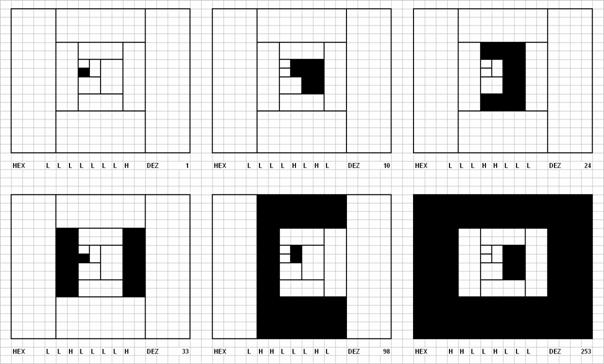
Each subdivision is only switched, no requirements regarding linearity remain, only deflection have to be very equal in all cells. In principle all solutions possible, no matter whether dynamic, piezoelectic or electrostatic. But the single elements must change its level very fast. Only one cycle of the sampling frequency remain for changing the condition. Thus, only very small elements are suitable. At the Carnegy Mellone University already realised the digital loudspeakers as integrated approach. However, those tiny speakers currently intended for communication purpose alone, because eight bit resolution are causing only around -40 dB quantisation noise, inacceptable for HiFi - solutions.
Possibly in the acoustic curtain as using for the described Holophony approach sufficient amount of single speakers supply the sound pressure on the listeners point. Each elementary wave settles different distance to the listener. By that reason the levels of the quantisation steps are little different by this point. Besides, all elements would be working together, neighbouring speaker's posse's common movement of its diaphragm at lower frequencies. Thus the perfect air resistance adaption causing high efficiency, very small excursions produce sufficient sound pressure down to the main range.
However, other fundamental problems will remain still. The clock frequencie will cause unacceptably high ultrasonic level. We cannot hear it, but the high sound pressure may cause healthy problems. Besides unsolved Aliasing problems exist. From this reason we will purchase the digitally guided analog loudspeakers, praised as Super- Duper Digital Loudspeaker, also in the near future.

